Class: http — JSON over HTTP as an outbound client . Sources poll a remote URL and publish to a stream ; sinks subscribe to a stream and POST batches to a REST endpoint . Listen / webhook ingest is http_server
Create and edit under Sources Sinks Advanced Settings may expose more runtime options depending on deployment and permissions.
Source and sink behavior
Role Behavior Source HTTP client (often GET polling) pulls JSON and emits events to the connector stream . Sink HTTP client sends event batches to endpointPOST ). Streams Upstream processing must publish to the stream the sink subscribes to; the source writes the stream tasks consume (Streams ).
Defaults (Core): if methodGET for sources and POST for sinks.
Required fields
Every connector row
Field Required Notes nameYes Display name; id derived from it. classYes Must be http. streamYes Resolved stream id. typeYes source or sink from the screen used at create time.configYes Class-specific object; see below.
Class http — required configuration
Setting Required Notes endpointYes HTTP(S) URL for poll or delivery.
Create connector
Open Sources Sinks Create .
Set Class to HTTP , set name, stream behavior, and Enabled .
Enter endpointmethod
Add auth, TLS, intervals, and batching from Common configuration when needed.
Save , then wire the stream into tasks / pipelines .
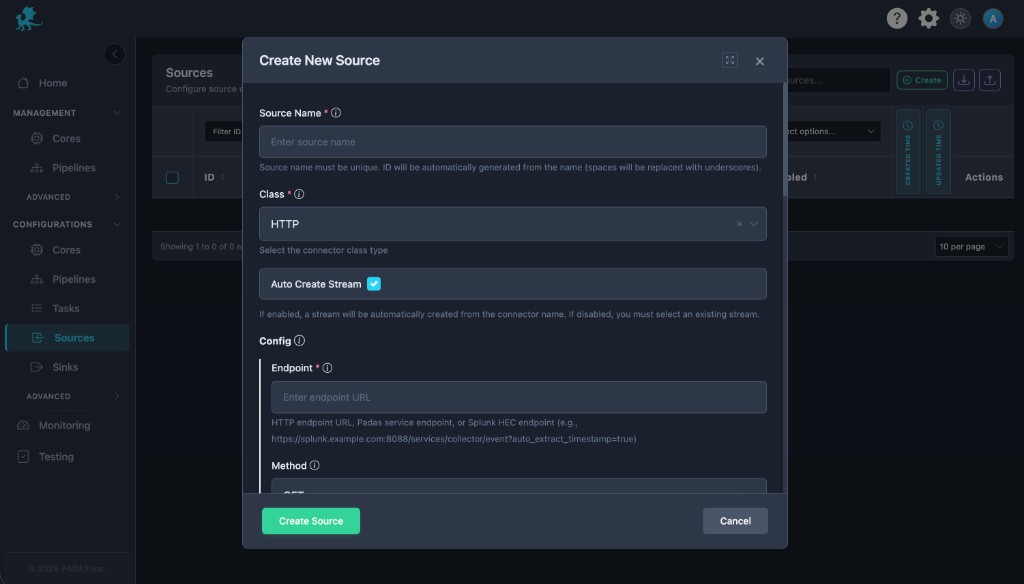
Source (UI)
The HTTP source connector form. UI field Connector setting Endpoint (required)endpointMethod method (e.g. GET for polling sources)
Sink (UI)
Same Config layout on Create New Sink ; titles and primary button differ.
The HTTP sink connector form. UI field Connector setting Endpoint (required)endpointMethod method (usually POST for sinks)
Configuration
Request and delivery
methodendpointinterval_mstimeout_secondsretry_attempts
Authentication
authentication
Payload batching
batchmax_events, timeout_ms, max_bytes for grouped reads or posts.
Compression and TLS
compressioncompression_thresholdtls
Runtime behavior
Connectors run after deployment; Disabled connectors do not call remote HTTP.
Sources respect poll intervals and timeouts; sinks flush batches per batch and retry policy.Downstream stream wiring must match task sink_streams / source_stream expectations.
Keep timeouts below upstream SLAs; tune retry_attempts
Cap batch
Use TLS verification in production; document any custom trust stores.
Related pages